what is the relative mass of one atom of h to one atom of c?
Atomic Mass
Atomic mass is based on a relative scale and the mass of 12C (carbon twelve) is defined as 12 amu.
Why do we specify 12C? We do not simply state the the mass of a C atom is 12 amu because elements exist every bit a variety of isotopes.
Carbon exists equally two major isotopes, 12C, and thirteenC (14C exists and has a half life of 5730 y, 10C and 11C also exist; their half lives are xix.45 min and xx.3 days respectively). Each carbon atom has the aforementioned number of protons and electrons, vi. 12C has 6 neutrons, 13C has 7 neutrons, and 14C has viii neutrons and so on. Since in that location are a variety of carbon isotopes we must specify which C atom defines the calibration.
All the masses of the elements are determined relative to 12C.
By the way, the mass of an chemical element is not equal to the sum of the masses of the subatomic particles of which the chemical element is made!
Boilerplate Atomic Mass
Since many elements have a number of isotopes, and since chemists rarely work with i cantlet at a time, chemists use average atomic mass.
On the periodic table the mass of carbon is reported as 12.01 amu. This is the average diminutive mass of carbon. No unmarried carbon atom has a mass of 12.01 amu, but in a handful of C atoms the average mass of the carbon atoms is 12.01 amu.
Why 12.01 amu?
If a sample of carbon was placed in a mass spectrometer the spectrometer would detect ii different C atoms, 12C and 13C.
The natural abundances of 14C, 10C and 11C are so low that most mass spectrometers cannot detect the consequence these isotopes have on the average mass. 14C dating is accomplished by measuring the radioactive decay of a sample, not by actually counting the number of 14C atoms.
The average mass of a carbon is calculated from the information the mass spectrometer collects.
The mass spectrometer reports that at that place are two isotopes of carbon,
98.99% of the sample has a mass of 12 amu (non a surprise since this is the atom on which the scale is based).1.11% of the sample has a mass of 13.003355 amu (this isotope is 1.0836129 times as massive as 12C)
The average mass is simply a weighted average.


ave. mass = 12.01 amu
(Aye, the number 12.01 has the right number of meaning figures, fifty-fifty though 1.eleven% only has 3 significant figures.)
If we know the natural abundance (the natural abundance of an isotope of an element is the pct of that isotope as it occurs in a sample on globe) of all the isotopes and the mass of all the isotopes we tin can notice the average atomic mass. The average diminutive mass is just a weighted average of the masses of all the isotopes.
| | | |
| | | |
| | | |
| | | |

(Yes, the sig figs are correct .)
Some other kind of question could be asked...
Copper has two isotopes 63Cu and 65Cu. The diminutive mass of copper is 63.54. The atomic masses of 63Cu and 65Cu are 62.9296 and 64.9278 amu respectively; what is the natural abundance of each isotope?

substituting gives
 (eq. A)
I equation and two unknowns...is there another equation? If there is another equation we would accept ii equations and two unknowns, and a system of 2 equations and ii unknowns is solvable.
Since in that location are only two major isotopes of Cu we know that

or
 (eq. B)
Utilize eq. B to substitute for %63Cu in eq. A.
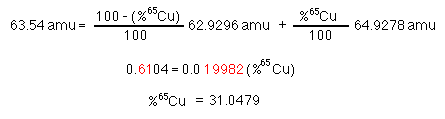
To the right number of significant figures

Of course, a question similar the one above could be turned around another way.
Gallium, atomic mass 69.72 amu, has two major isotopes, 69Ga, atomic mass 68.9257 amu, and 71Ga. If the natural affluence of each isotope is 60.00 and 40.00 % respectively what is the mass (in amu) of 71Ga.
The mole
| | | |
| | | |
| | | |
| | | |
What is the relative mass of 1 C atom as compared to 1 H atom?
What is the relative mass of 100 C atoms as compared to 100 H atoms?
What is the relative mass of 1 W cantlet as compared to one H atom?
What is the relative mass of 100 West atoms every bit compared to 100 H atoms?
The point hither? As long every bit the number of atoms remains the same the relative mass does not change.
Atoms are modest, and it is possible to place 1.0079 chiliad of H on a residue (possible merely non easy in the example of hydrogen).
It is too possible to identify 183.ix g Westward, or 12.01 g of C on a balance.
Now, I state with absolute certainty that I have placed the aforementioned number of atoms on each remainder! How practice I know? I know because the relative masses of the samples on the residuum, are the aforementioned every bit the relative masses of the individual atoms.
C:H = (12.01 g/1.0079 g):1 = 11.92:1
The number of atoms I placed on the residuum is know as a mole.
For many years the number of atoms in a mole remained unknown; still, at present it is know that a mole of atoms contains vi.02214 10 x23 atoms.
So, the periodic table provides united states of america with a nifty bargain of information.
The periodic table lists
the mass of a mole of atoms (i.e. the molar mass) in grams,
and the mass of half-dozen.02214 10 x23 atoms in grams
The atomic mass of C is 12.01 amu. What is the mass of 1 C atom?

return to GenChem Abode Folio
Source: https://www.westfield.ma.edu/PersonalPages/cmasi/gen_chem1/Atomic%20and%20molar%20mass/atomic_and_molar_mass.htm
0 Response to "what is the relative mass of one atom of h to one atom of c?"
Post a Comment