Blue Cross 5 Day Reviews Skilled Nursing Stay
The word "nurse" originally came from the Latin word "nutrire", meaning to suckle, referring to a wet-nurse; just in the belatedly 16th century did it attain its modernistic meaning of a person who cares for the infirm.[1]
From the earliest times nigh cultures produced a stream of nurses defended to service on religious principles. Both Christendom and the Muslim Earth generated a stream of defended nurses from their earliest days. In Europe before the foundation of modernistic nursing, Catholic nuns and the military often provided nursing-like services.[2] Information technology took until the 19th century for nursing to get a secular profession.
Ancient history [edit]
The early history of nurses suffers from a lack of source material, but nursing in general has long been an extension of the wet-nurse function of women.[3] [4]
Buddhist Indian ruler (268 BC to 232 BC) Ashoka erected a series of pillars, which included an edict ordering hospitals to exist built along the routes of travelers, and that they be "well provided with instruments and medicine, consisting of mineral and vegetable drugs, with roots and fruits"; "Whenever there is no provision of drugs, medical roots, and herbs, they are to exist supplied, and adept physicians appointed at the expense of the land to administer them." The system of public hospitals continued until the fall of Buddhism in India ca. AD 750.
Virtually 100 BC the Charaka Samhita was written in India, stating that good medical do requires a patient, dr., nurse, and medicines, with the nurse required to be knowledgeable, skilled at preparing formulations and dosage, sympathetic towards anybody, and clean.
The first known Christian nurse, Phoebe, is mentioned in Romans 16:1. During the early years of the Christian Church building (ca. Advertizing 50), St. Paul sent a deaconess named Phoebe to Rome as the first visiting nurse.[5]
From its primeval days, following the edicts of Jesus, Christianity encouraged its devotees to tend the sick. Priests were often also physicians. Co-ordinate to the historian Geoffrey Blainey, while infidel religions seldom offered assist to the infirm, the early on Christians were willing to nurse the sick and take food to them, notably during the smallpox epidemic of Advertizement 165-180 and the measles outbreak of around AD 250; "In nursing the ill and dying, regardless of religion, the Christians won friends and sympathisers".[6]
Following the First Council of Nicaea in AD 325, Christianity became the official faith of the Roman Empire, leading to an expansion of the provision of care. Among the earliest were those built ca. 370 by St. Basil the Great, bishop of Caesarea Mazaca in Cappadocia in Asia Minor (modern-day Turkey), past Saint Fabiola in Rome ca. 390, and past the physician-priest Saint Sampson (d. 530) in Constantinople, Chosen the Basiliad, St. Basil'due south hospital resembled a city, and included housing for doctors and nurses and separate buildings for various classes of patients.[7] At that place was a separate section for lepers.[8] Eventually structure of a hospital in every cathedral town was begun.
Christian accent on applied charity gave rise to the development of systematic nursing and hospitals after the end of the persecution of the early church building.[9] Ancient church leaders like St. Benedict of Nursia (480-547) emphasized medicine as an aid to the provision of hospitality.[x] twelfth century Roman Cosmic orders like the Dominicans and Carmelites take long lived in religious communities that work for the care of the sick.[eleven]
Some hospitals maintained libraries and training programs, and doctors compiled their medical and pharmacological studies in manuscripts. Thus in-patient medical care in the sense of what we today consider a hospital, was an invention driven by Christian mercy and Byzantine innovation.[12] Byzantine hospital staff included the Primary Doc (archiatroi), professional nurses (hypourgoi) and orderlies (hyperetai). By the twelfth century, Constantinople had two well-organized hospitals, staffed by doctors who were both male person and female. Facilities included systematic treatment procedures and specialized wards for various diseases.[xiii]
In the early 7th century, Rufaidah bint Sa'ad (also known as Rufaida Al-Aslamia) became what is now described as the first Muslim nurse. A contemporary of Muhammad, she hailed from the Bani Aslam tribe in Medina and learned her medical skills from her father, a traditional healer. Subsequently she had led a group of women to treat injured fighters on the battlefield, Muhammad gave her permission to fix a tent near the Medina mosque to provide treatment and care for the sick and the needy.[xiv]
Medieval Europe [edit]
Medieval hospitals in Europe followed a similar pattern to the Byzantine. They were religious communities, with intendance provided past monks and nuns. (An old French term for hospital is hôtel-Dieu, "hostel of God.") Some were fastened to monasteries; others were independent and had their own endowments, usually of property, which provided income for their back up. Some hospitals were multi-functional while others were founded for specific purposes such as leper hospitals, or every bit refuges for the poor, or for pilgrims: not all cared for the sick. The first Spanish hospital, founded by the Catholic Visigoth bishop Masona in Ad 580 at Mérida, was a xenodochium designed as an inn for travellers (by and large pilgrims to the shrine of Eulalia of Mérida) also every bit a hospital for citizens and local farmers. The hospital's endowment consisted of farms to feed its patients and guests. From the business relationship given by Paul the Deacon we learn that this hospital was supplied with physicians and nurses, whose mission included the care the ill wherever they were found, "slave or costless, Christian or Jew."[15]
During the late 700s and early on 800s, Emperor Charlemagne decreed that those hospitals which had been well conducted before his time and had fallen into decay should be restored in accordance with the needs of the time.[sixteen] He further ordered that a hospital should be attached to each cathedral and monastery.[16]
During the tenth century the monasteries became a dominant gene in infirmary work. The famous Benedictine Abbey of Cluny, founded in 910, set the example which was widely imitated throughout France and Federal republic of germany. Besides its infirmary for the religious, each monastery had a hospital in which externs were cared for. These were in charge of the eleemosynarius , whose duties, advisedly prescribed by the dominion, included every sort of service that the visitor or patient could require.
As the eleemosynarius was obliged to seek out the sick and needy in the neighborhood, each monastery became a center for the relief of suffering. Amongst the monasteries notable in this respect were those of the Benedictines at Corbie in Picardy, Hirschau, Braunweiler, Deutz, Ilsenburg, Liesborn, Pram, and Fulda; those of the Cistercians at Arnsberg, Baumgarten, Eberbach, Himmenrode, Herrnalb, Volkenrode, and Walkenried.
No less efficient was the work done by the diocesan clergy in accordance with the disciplinary enactments of the councils of Aachen (817, 836), which prescribed that a hospital should be maintained in connection with each collegiate church. The canons were obliged to contribute towards the support of the hospital, and one of their number had charge of the inmates. As these hospitals were located in cities, more than numerous demands were made upon them than upon those attached to the monasteries. In this motion the bishop naturally took the lead, hence the hospitals founded by Heribert (d. 1021) in Cologne, Godard (d. 1038) in Hildesheim, Conrad (d. 975) in Constance, and Ulrich (d. 973) in Augsburg. Only similar provision was made by the other churches; thus at Trier the hospitals of St. Maximin, St. Matthew, St. Simeon, and St. James took their names from the churches to which they were attached. During the period 1207–1577 no less than 155 hospitals were founded in Deutschland.[17]
The Ospedale Maggiore, traditionally named Ca' Granda (i.east. Big House), in Milan, northern Italy, was constructed to house one of the start community hospitals, the largest such undertaking of the fifteenth century. Deputed by Francesco Sforza in 1456 and designed by Antonio Filarete it is amongst the first examples of Renaissance architecture in Lombardy.
The Normans brought their infirmary system along when they conquered England in 1066. By merging with traditional land-tenure and customs, the new charitable houses became pop and were distinct from both English language monasteries and French hospitals. They dispensed alms and some medicine, and were generously endowed by the nobility and gentry who counted on them for spiritual rewards afterward death.[xviii]
According to Geoffrey Blainey, the Catholic Church in Europe provided many of the services of a welfare land: "Information technology conducted hospitals for the old and orphanages for the immature; hospices for the ill of all ages; places for the lepers; and hostels or inns where pilgrims could buy a cheap bed and meal". It supplied food to the population during famine and distributed nutrient to the poor. This welfare organization the church funded through collecting taxes on a big scale and possessing large farmlands and estates.[xix]
Roles for women [edit]
Catholic women played large roles in health and healing in medieval and early modern Europe.[xx] A life equally a nun was a prestigious role; wealthy families provided dowries for their daughters, and these funded the convents, while the nuns provided free nursing intendance for the poor.[21]
Meanwhile, in Catholic lands such as French republic, rich families connected to fund convents and monasteries, and enrolled their daughters equally nuns who provided free wellness services to the poor. Nursing was a religious role for the nurse, and at that place was petty phone call for science.[22]
Heart East [edit]
The Eastern Orthodox Church building had established many hospitals in the Middle Due east, but following the rise of Islam from the 7th century, Standard arabic medicine developed in this region, where a number of important advances were made and an Islamic tradition of nursing begun. Arab ideas were later influential in Europe. The famous Knights Hospitaller arose as a group of individuals associated with an Amalfitan infirmary in Jerusalem, which was built to provide care for poor, ill or injured Christian pilgrims to the Holy Land. Following the capture of the city past Crusaders, the social club became a armed services as well as infirmarian society.[23]
Roman Cosmic orders such as the Franciscans stressed tending the sick, especially during the devastating plagues.[24]
Early on modern Europe [edit]

Catholic Europe [edit]
The Cosmic elites provided infirmary services considering of their theology of salvation that holds that organized religion accompanied by adept works were the route to heaven.[25] The same theology holds strong into the 21st century. In Cosmic areas, the tradition of nursing sisters continued uninterrupted. Several orders of nuns provided nursing services in hospitals.[26] A leadership part was taken past the Daughters of Charity of Saint Vincent de Paul, founded in France in 1633.[27] New orders of Catholic nuns expanded the range of activities and reached new areas. For example, in rural Brittany in French republic, the Daughters of the Holy Spirit, created in 1706, played a central role. New opportunity for nuns as charitable practitioners were created by devout nobles on their ain estates. The nuns provided comprehensive care for the sick poor on their patrons' estates, acting not only every bit nurses, but took on expanded roles as physicians, surgeons, and apothecaries. The French Catholics in New France (Canada) and New Orleans continued these traditions. During the French Revolution, most of the orders of nurses were shut downwards and there was no organized nursing care to replace them.[22] However the demand for their nursing services remained strong, and subsequently 1800 the sisters reappeared and resumed their piece of work in hospitals and on rural estates. They were tolerated past officials because they had widespread support and were the link between elite physicians and distrustful peasants who needed help.[28]
Protestantism closes the hospitals [edit]
The Protestant reformers, led by Martin Luther, rejected the notion that rich men could gain God's grace through good works—and thereby escape purgatory—by providing cash endowments to charitable institutions. They as well rejected the Catholic idea that the poor patients earned grace and salvation through their suffering.[29] Protestants by and large closed all the convents[30] and most of the hospitals, sending women domicile to go housewives, often confronting their will.[31] On the other manus, local officials recognized the public value of hospitals, and some were continued in Protestant lands, merely without monks or nuns and in the control of local governments.[32]
In London, the crown allowed ii hospitals to continue their charitable work, under nonreligious control of metropolis officials.[33] The convents were all shut down but Harkness finds that women—some of them old nuns—were part of a new organisation that delivered essential medical services to people outside their family. They were employed past parishes and hospitals, also equally by individual families, and provided nursing care as well every bit some medical, pharmaceutical, and surgical services.[34]
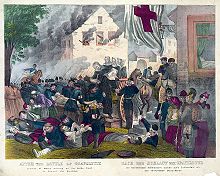
"After the Boxing of Gravelotte. The French Sisters of Mercy of St. Borromeo arriving on the battle field to succor the wounded." Unsigned lithograph, 1870 or 1871.
In the 16th century, Protestant reformers shut down the monasteries and convents, though they allowed a few to go along in operation. Those nuns who had been serving as nurses were given pensions or told to get married and stay dwelling house.[30] Between 1600 and 1800, Protestant Europe had a few notable hospitals, but no regular arrangement of nursing. The weakened public role of women left female practitioners restricted to assisting neighbors and family in an unpaid and unrecognized capacity.[35]
Modernistic [edit]
Modernistic nursing began in the 19th century in Deutschland and Britain, and spread worldwide past 1900.
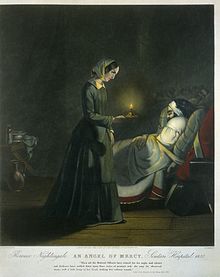
Florence Nightingale, an 'affections of mercy', set her nursing school in 1860
Deaconess [edit]
Phoebe, the nurse mentioned in the New Testament, was a deaconess. The role had virtually died out centuries before, but was revived in Germany in 1836 when Theodor Fliedner and his wife Friederike Münster opened the first deaconess motherhouse in Kaiserswerth on the Rhine. The diaconate was soon brought to England and Scandinavia, Kaiserswerth model. The women obligated themselves for five years of service, receiving room, lath, uniforms, pocket money, and lifelong care. The uniform was the usual apparel of the married adult female. There were variations, such as an emphasis on preparing women for wedlock through training in nursing, child care, social work and housework. In the Anglican Church, the diaconate was an auxiliary to the pastorate, and there were no female parent houses. By 1890 there were over v,000 deaconesses in Protestant Europe, chiefly Germany, Scandinavia, and England. In World War Two, diaconates in state of war zones sustained heavy damage. As eastern Europe fell to communism, most diaconates were shut downwardly, and 7,000 deaconesses became refugees in Due west Germany. By 1957, in Frg in that location were 46,000 deaconesses and 10,000 assembly. Other countries reported a total of xiv,000 deaconesses, most of them Lutherans. In the The states and Canada 1,550 women were counted, half of them in the Methodist Church.[36]
William Passavant in 1849 brought the get-go four deaconesses to Pittsburgh, after visiting Kaiserswerth. They worked at the Pittsburgh Infirmary (now Passavant Hospital).[37] Betwixt 1880 and 1915, 62 training schools were opened in the U.s.. The lack of grooming had weakened Passavant's programs. However recruiting became increasingly hard afterwards 1910 equally women preferred graduate nursing schools or the social work curriculum offered past country universities.[38]
Nightingale'due south Britain [edit]
The Crimean War was a pregnant development in nursing history when English nurse Florence Nightingale laid the foundations of professional person nursing with the principles summarised in the book Notes on Nursing. Nightingale arrived in Crimea in 1855, where she became known as "The Lady with the Lamp." She would visit and minister to the wounded all-day and dark. In Crimea, she managed and trained a group of nurses who tended to injured soldiers. When she arrived at Scutari, the British hospital base of operations in Constantinople, she found bloodcurdling conditions and a lack of hygiene. The hospital was dirty and filled with excrement and rodents. Supplies, food, and fifty-fifty h2o were in brusque supply. Nightingale organized the cleaning of the entire infirmary, ordered supplies, and implemented hygienic procedures such as manus washing to preclude the spread of infection. Some credit Nightingale with significantly reducing the death rate at the hospital, on account of her advancement for proper supplies and sanitary procedures. A fund was fix upwardly in 1855 by members of the public to raise money for Florence Nightingale and her nurses' piece of work[39] In 1856, £44,039 (equivalent to roughly over £ii meg today) was pooled and with this Nightingale decided to use the money to lay the foundations for a training schoolhouse at St Thomas' Hospital. In 1860, the preparation for the first batch of nurses began; upon graduation from the school, these nurses used to be called 'Nightingales'.[40] Nightingale's gimmicky, Mary Seacole, was a Jamaican "doctress" who also nursed soldiers who were wounded during the Crimean State of war, and in the tradition of Jamaican doctresses, Seacole practised the hygiene that was later adopted past Nightingale in her writings after the Crimean State of war.[41] [42] [43]
Nightingale'southward revelation of the abysmal nursing care afforded soldiers in the Crimean State of war energized reformers. Queen Victoria in 1860 ordered a hospital to be built to train Army nurses and surgeons, the Purple Victoria Hospital. The infirmary opened in 1863 in Netley and admitted and cared for military patients. Beginning in 1866, nurses were formally appointed to Armed forces General Hospitals. The Army Nursing Service (ANS) oversaw the piece of work of the nurses starting in 1881. These military nurses were sent overseas beginning with the Offset Boer State of war (frequently chosen Zulu War) from 1879 to 1881.[44] They were likewise dispatched to serve during the Egyptian Campaign in 1882 and the Sudan War of 1883 to 1884. During the Sudan State of war members of the Ground forces Nursing Service nursed in hospital ships on the Nile equally well as the Citadel in Cairo. Well-nigh 2000 nurses served during the second Boer War, the Anglo-Boer War of 1899 to 1902, alongside nurses who were part of the colonial armies of Australia, Canada and New Zealand. They served in tented field hospitals. 23 Army Nursing sisters from Uk lost their lives from disease outbreaks.[45]
New Zealand [edit]
New Zealand was the start state to regulate nurses nationally, with adoption of the Nurses Registration Act on the 12 September 1901. It was hither in New Zealand that Ellen Dougherty became the first registered nurse.[46]
Canada [edit]
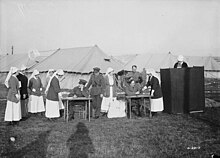
Nursing sisters at a Canadian armed forces hospital in France voting in the Canadian federal election, 1917
Canadian nursing dates all the way back to 1639 in Quebec with the Augustine nuns. These nuns were trying to open up a mission that cared for the spiritual and physical needs of patients. The establishment of this mission created the beginning nursing apprenticeship grooming in Northward America.[47]
In the nineteenth century, there were some Catholic orders of nursing that were trying to spread their message beyond Canada. These women had only an occasional consultation with a doc. Towards the end of the nineteenth-century hospital care and medical services had been improved and expanded. Much of this was due to the Nightingale model, which prevailed in English Canada. In 1874 the showtime formal nursing preparation program was started at the General and Marine Hospital in St. Catharines in Ontario.[47] Many programs popped up in hospitals across Canada after this one was established. Graduates and teachers from these programs began to fight for licensing legislation, nursing journals, university training for nurses, and for professional person organizations for nurses.
The commencement example of Canadian nurses and the military was in 1885 with the North-West Rebellion. Some nurses came out to aid the wounded. In 1901 Canadian nurses were officially part of the Royal Canadian Army Medical Corps.[47] Georgina Fane Pope and Margaret C. MacDonald were the first nurses officially recognized as armed services nurses.[47]
Canadian missionary nurses were also of great importance in Henan, Red china as a role of the North China Mission starting in 1888.
In the tardily nineteenth and early twentieth centuries, women made inroads into various professions including instruction, journalism, social work, and public wellness. These advances included the establishment of a Women's Medical Higher in Toronto (and in Kingston, Ontario) in 1883, attributed in office to the persistence of Emily Stowe, the starting time female person doctor to exercise in Canada. Stowe's daughter, Augusta Stowe-Gullen, became the first woman to graduate from a Canadian medical school.[48]
Apart from a token few, women were outsiders to the male-dominated medical profession. As physicians became meliorate organized, they successfully had laws passed to control the practice of medicine and pharmacy and banning marginal and traditional practitioners. Midwifery—practiced along traditional lines by women—was restricted and practically died out past 1900.[49] Withal, the groovy majority of childbirths took place at home until the 1920s, when hospitals became preferred, especially by women who were better educated, more modern, and more than trusting in mod medicine.[fifty]
Prairie provinces [edit]
In the Prairie provinces, the first homesteaders relied on themselves for medical services. Poverty and geographic isolation empowered women to learn and do medical care with the herbs, roots, and berries that worked for their mothers. They prayed for divine intervention but besides practiced supernatural magic that provided as much psychological as concrete relief. The reliance on homeopathic remedies continued equally trained nurses and doctors and how-to manuals slowly reached the homesteaders in the early 20th century.[51]
After 1900 medicine and specially nursing modernized and became well organized.
The Lethbridge Nursing Mission in Alberta was a representative Canadian voluntary mission. It was founded, independent of the Victorian Order of Nurses, in 1909 by Jessie Turnbull Robinson. A onetime nurse, Robinson was elected as president of the Lethbridge Relief Society and began district nursing services aimed at poor women and children. The mission was governed by a volunteer board of women directors and began by raising money for its beginning year of service through charitable donations and payments from the Metropolitan Life Insurance Company. The mission also blended social piece of work with nursing, becoming the dispenser of unemployment relief.[52]
Richardson (1998) examines the social, political, economic, class, and professional person factors that contributed to ideological and practical differences between leaders of the Alberta Association of Graduate Nurses (AAGN), established in 1916, and the United Subcontract Women of Alberta (UFWA), founded in 1915, regarding the promotion and credence of midwifery every bit a recognized subspecialty of registered nurses. Accusing the AAGN of ignoring the medical needs of rural Alberta women, the leaders of the UFWA worked to ameliorate economic and living atmospheric condition of women farmers. Irene Parlby, the UFWA's showtime president, lobbied for the establishment of a provincial Department of Public Health, authorities-provided hospitals and doctors, and passage of a law to allow nurses to qualify every bit registered midwives. The AAGN leadership opposed midwife certification, arguing that nursing curricula left no room for midwife written report, and thus nurses were non qualified to participate in home births. In 1919 the AAGN compromised with the UFWA, and they worked together for the passage of the Public Health Nurses Deed that allowed nurses to serve as midwives in regions without doctors. Thus, Alberta's District Nursing Service, created in 1919 to coordinate the province'southward women's health resources, resulted chiefly from the organized, persistent political activism of UFWA members and only minimally from the actions of professional person nursing groups conspicuously uninterested in rural Canadians' medical needs.[53]
The Alberta Commune Nursing Service administered health care in the predominantly rural and impoverished areas of Alberta in the commencement half of the 20th century. Founded in 1919 to meet maternal and emergency medical needs by the United Farm Women (UFWA), the Nursing Service treated prairie settlers living in primitive areas lacking doctors and hospitals. Nurses provided prenatal care, worked as midwives, performed small surgery, conducted medical inspections of schoolchildren, and sponsored immunization programs. The post-Second World War discovery of big oil and gas reserves resulted in economic prosperity and the expansion of local medical services. The passage of provincial health and universal hospital insurance in 1957 precipitated the eventual phasing out of the obsolete District Nursing Service in 1976.[54]
Recent trends [edit]
Afterwards World War Ii, the wellness care system expanded and was nationalized with Medicare. Currently at that place are 260,000 nurses in Canada only they face the aforementioned difficulties equally most countries, as technology advances and the aging population requires more nursing care.
Mexico [edit]

During almost of United mexican states's wars in the nineteenth and early on twentieth centuries, camp followers known as soldaderas nursed soldiers wounded in warfare.[55] During the Mexican Revolution (1910-1920) care of soldiers in northern Mexico was likewise undertaken by the Neutral White Cross, founded by Elena Arizmendi Mejia afterward the Mexican Red Cross refused to treat revolutionary soldiers. The Neutral White Cross treated soldiers regardless of their faction.
French republic [edit]
Professionalization of nursing in French republic came in the late 19th and early 20th century. In 1870 France'southward 1,500 hospitals were operated by 11,000 Cosmic sisters; by 1911 there were xv,000 nuns representing over 200 religious orders. Government policy after 1900 was to secularize public institutions, and diminish the role the Cosmic Churches. The lay staff was enlarged from 14,000 in 1890 to 95,000 in 1911. This political goal came in disharmonize with the demand to maintain meliorate quality of medical intendance in blowsy facilities.[56] Many doctors, while personally anti-clerical, realized their dependence on the Catholic sisters. Most lay nurses came from peasant or working-class families and were poorly trained. Faced with the long hours and low pay, many before long married and left the field, while the Catholic sisters had renounced spousal relationship and saw nursing as their God-given vocation. New government-operated nursing schools turned out nonreligious nurses who were slated for supervisory roles. During the Globe State of war, an outpouring of patriotic volunteers brought big numbers of untrained eye-class women into the military machine hospitals. They left when the state of war ended simply the long-term effect was to heighten the prestige of nursing. In 1922 the regime issued a national diploma for nursing.[57]
The states [edit]
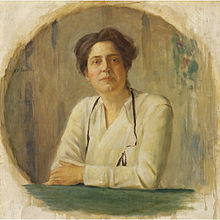

Saint Marianne Cope was among many Catholic nuns to influence the development of modern hospitals and nursing.
Nursing professionalized speedily in the late 19th century as larger hospitals set up nursing schools that attracted ambitious women from middle- and working-form backgrounds. Agnes Elizabeth Jones and Linda Richards established quality nursing schools in the U.S. and Japan; Linda Richards was officially America's first professionally trained nurse, having been trained at Florence Nightingale'southward training school, and subsequently graduating in 1873 from the New England Infirmary for Women and Children in Boston
In the early 1900s, the autonomous, nursing-controlled, Nightingale-era schools came to an end. Despite the institution of university-affiliated nursing schools, such as Columbia and Yale, hospital training programs were dominant. Formal "book learning" was discouraged in favor of clinical feel through an apprenticeship. In society to meet a growing demand, hospitals used student nurses as cheap labor at the expense of quality formal pedagogy.[58]
Jamaica [edit]
Mary Seacole came from a long line of Jamaican nurses, or "doctresses", who worked at healing British soldiers and sailors at the Jamaican military base of Port Imperial. These doctresses of the eighteenth century used good hygiene and herbal remedies to nurse their clients back to wellness. In the eighteenth century, these doctresses included Seacole's female parent, who was a mixed-race woman who was most likely a child of a slave, and who acquired medical knowledge of herbal remedies from West African ancestors.[59] Other 18th century doctresses included Sarah Adams and Grace Donne, the mistress and healer to Jamaica'due south wealthiest planter, Simon Taylor. Another eighteenth century doctress was Cubah Cornwallis, who nursed back to health famous sailors such equally the young Horatio Nelson, 1st Viscount Nelson and Crewman Beak, who later became William Iv of the U.k..[60]
Hospitals [edit]
The number of hospitals grew from 149 in 1873 to 4,400 in 1910 (with 420,000 beds)[61] to 6,300 in 1933, primarily because the public trusted hospitals more and could afford more than intensive and professional intendance.[62]
They were operated by city, state and federal agencies, by churches, by stand-alone not-profits, and by for-profit enterprises run by a local doctor. All the major denominations congenital hospitals; in 1915, the Cosmic Church ran 541, staffed primarily by unpaid nuns.[63] The others sometimes had a minor core of deaconesses equally staff. Most larger hospitals operated a schoolhouse of nursing, which provided grooming to young women, who in plow did much of the staffing on an unpaid footing. The number of active graduate nurses rose rapidly from 51,000 in 1910 to 375,000 in 1940 and 700,000 in 1970.[64]
The Protestant churches reentered the wellness field, especially by setting upwardly orders of women, called deaconesses who dedicated themselves to nursing services.
The modern deaconess motion began in Germany in 1836 when Theodor Fliedner and his wife opened the first deaconess motherhouse in Kaiserswerth on the Rhine. It became a model and within a half century were over 5,000 deaconesses in Europe. The Chursh of England named its outset deaconess in 1862. The Due north London Deaconess Institution trained deaconesses for other dioceses and some served overseas.[65]
William Passavant in 1849 brought the kickoff four deaconesses to Pittsburgh, in the United States, later on visiting Kaiserswerth. They worked at the Pittsburgh Infirmary (at present Passavant Hospital).[66]
The American Methodists – the largest Protestant denomination—engaged in large-scale missionary activity in Asia and elsewhere in the world, making medical services a priority as early as the 1850s. Methodists in America took notation, and began opening their ain charitable institutions such equally orphanages and old people's homes after 1860. In the 1880s, Methodists began opening hospitals in the United States, which served people of all religious backgrounds behavior. By 1895 xiii hospitals were in performance in major cities.[67]
In 1884, U.South. Lutherans, particularly John D. Lankenau, brought 7 sisters from Germany to run the German Hospital in Philadelphia.
By 1963, the Lutheran Church in America had centers for deaconess piece of work in Philadelphia, Baltimore, and Omaha.[68]
Public wellness [edit]

February 1918 drawing by Marguerite Martyn of a public-health nurse in St. Louis, Missouri, with medicine and babies
In the U.S., the role of public health nurse began in Los Angeles in 1898, by 1924 in that location were 12,000 public health nurses, half of them in the 100 largest cities. Their average annual salary in larger cities was $i,390. In addition, there were thousands of nurses employed by individual agencies handling similar piece of work. Public health nurses supervised health issues in the public and parochial schools, to prenatal and infant intendance, handled communicable diseases and tuberculosis and dealt with an aerial diseases.[69]
During the Castilian–American War of 1898, medical atmospheric condition in the tropical war zone were dangerous, with yellow fever and malaria owned. The United States government chosen for women to volunteer as nurses. Thousands did so, merely few were professionally trained. Among the latter were 250 Cosmic nurses, almost of them from the Daughters of Charity of St. Vincent de Paul.[70]
Nursing schools [edit]
Sporadic progress was made on several continents, where medical pioneers established formal nursing schools. But even as late as the 1870s, "women working in Due north American urban hospitals typically were untrained, working course, and accorded lowly status by both the medical profession they supported and society at big". Nursing had the same condition in Great Britain and continental Europe before World State of war I.[71]
Hospital nursing schools in the United States and Canada took the lead in applying Nightingale'southward model to their training programmers:
standards of classroom and on-the-job preparation had risen sharply in the 1880s and 1890s, and along with them the expectation of decorous and professional conduct[71]
In tardily the 1920s, the women'southward specialties in health care included 294,000 trained nurses, 150,000 untrained nurses, 47,000 midwives, and 550,000 other hospital workers (most of them women).[72]
In contempo decades, professionalization has moved nursing degrees out of RN-oriented infirmary schools and into community colleges and universities. Specialization has brought numerous journals to broaden the knowledge base of the profession.
Earth War I [edit]
United kingdom of great britain and northern ireland [edit]
By the first of World War I, armed services nursing still had only a small role for women in Great britain; x,500 nurses enrolled in Queen Alexandra's Imperial Military Nursing Service (QAIMNS) and the Princess Mary's Purple Air Force Nursing Service. These services dated to 1902 and 1918, and enjoyed imperial sponsorship. In that location also were Voluntary Aid Detachment (VAD) nurses who had been enrolled past the Scarlet Cross.[73] The ranks that were created for the new nursing services were Matron-in-Chief, Principal Matron, Sis and Staff Nurses. Women joined steadily throughout the War. At the terminate of 1914, there were ii,223 regular and reserve members of the QAIMNS and when the war concluded there were 10,404 trained nurses in the QAIMNS.[45]
Grace McDougall (1887–1963) was the energetic commandant of the Showtime Assist Nursing Yeomanry (FANY), which had formed in 1907 as an auxiliary to the home baby-sit in Britain. McDougall at one point was captured past the Germans but escaped. The British army wanted nothing to do with them so they collection ambulances and ran hospitals and prey clearing stations for the Belgian and French armies.[74] [75]
Canada [edit]
When Canadian nurses volunteered to serve during World War I, they were fabricated commissioned officers by the Canadian Army earlier being sent overseas,[76] a move that would grant them some authority in the ranks, so that enlisted patients and orderlies would have to comply with their direction. Canada was the first country in the world to grant women this privilege. At the beginning of the War, nurses were not dispatched to the prey clearing stations nearly the front lines, where they would be exposed to shell fire. They were initially assigned to hospitals a safe distance abroad from the forepart lines. As the war continued, notwithstanding, nurses were assigned to casualty immigration stations. They were exposed to shelling, and caring for soldiers with "shell shock" and casualties suffering the effects of new weapons such every bit poisonous gas, as Katherine Wilson-Sammie recollects in Lights Out! A Canadian Nursing Sister's Tale.[77] World State of war I was also the offset war in which a conspicuously marked hospital ship evacuating the wounded was targeted and sunk by an enemy submarine or torpedo boat, an act that had previously been considered unthinkable, but which happened repeatedly (encounter List of hospital ships sunk in World War I). Nurses were among the casualties.
Canadian women volunteering to serve overseas as nurses overwhelmed the ground forces with applications.[71] A total of three,141 Canadian "nursing sisters" served in the Canadian Regular army Medical Corps and 2,504 of those served overseas in England, France and the Eastern Mediterranean at Gallipoli, Alexandria and Salonika. By the end of the Offset World State of war, 46 Canadian Nursing Sisters had died[76] In add-on to these nurses serving overseas with the war machine, others volunteered and paid their own mode over with organizations such as the Canadian Blood-red Cantankerous, the Victorian Social club of Nurses, and St. John Ambulance. The sacrifices fabricated by these nurses during the War in fact gave a heave to the women'south suffrage movement in many of the countries that fought in the state of war. The Canadian Ground forces nursing sisters were among the first women in the world to win the right to vote in a federal election; the Military Voters Act of 1917 extended the vote to women in the service such as Nursing Sisters.
Commonwealth of australia [edit]
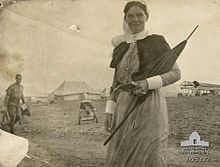
Sister Grace Wilson of the 3rd Australian General Infirmary on Lemnos. She sailed from Sydney, New South Wales on lath RMS Mooltan on 15 May 1915.[78]
Australian nurses served in the war as part of the Australian General Hospital. Australia established two hospitals at Lemnos and Heliopolis Islands to back up the Dardanelles campaign at Gallipoli. Nursing recruitment was sporadic, with some reserve nurses sent with the advance parties to gear up the transport transport HMAS Gascoyne while others simply fronted to Barracks and were accepted, while still others were expected to pay for their passage in steerage. Australian nurses from this period became known as "grey ghosts" because of their drab uniforms with starched neckband and cuffs.[ citation needed ]
During the course of the war, Australian nurses were granted their own administration rather than working under medical officers. Australian Nurses hold the tape for the maximum number of triage cases candy by a casualty station in a xx-4-60 minutes period during the boxing of Passchendale. Their work routinely included administering ether during haemostatic surgery and managing and preparation medical assistants (orderlies).[79]
Some 560 Australian ground forces nurses served in India during the state of war, where they had to overcome a debilitating climate, outbreaks of disease, insufficient numbers, overwork and hostile British Regular army officers.[80]
Interwar [edit]
Surveys in the U.S. showed that nurses often got married a few years later on graduation and quit work; other waited 5 to x years for wedlock; careerists some never married. By the 1920s increasing numbers of married nurses connected to piece of work. The high turnover meant that advancement could be rapid; the average historic period of a nursing supervisor in a hospital was merely 26 years. Wages for individual duty nurses were high in the 1920s—$1,300 a year when working full-time in patients' homes or at their individual rooms in hospitals. This was more than double what a woman could earn as a teacher or in office work. Rates fell sharply when the Great Depression came in 1929, and continuous work was much harder to observe.[81]
World War 2 [edit]
Canada [edit]
Over 4000 women served as nurses in compatible in the Canadian Armed Forces during the 2d Earth State of war. They were chosen "Nursing Sisters" and had already been professionally trained in civilian life. However, in military service they achieved an elite status well above what they had experienced every bit civilians. The Nursing Sisters had much more responsibility and autonomy, and had more opportunity to use their expertise, and then civilian nurses. They were oft close to the front lines, and the armed services doctors – all men – delegated significant responsibleness to the nurses considering of the loftier level of casualties, the shortages of physicians, and farthermost working conditions.[82] [83]
Commonwealth of australia [edit]

In 1942, sixty v forepart line nurses from the Full general Hospital Division in British Singapore were ordered aboard the Vyner Brook and Empire Star for evacuation, rather than caring for wounded. The ships were strafed with machine gun burn by Japanese planes. Sisters Vera Torney and Margaret Anderson were awarded medals when they could observe nothing else on the crowded deck and covered their patients with their ain bodies. A version of this activeness was honoured in the moving picture Paradise Route. The Vyner Brook was bombed and sank quickly in shallow h2o of the Sumatra Strait and all merely twenty-one were lost at ocean, presumed drowned. The remaining nurses swam ashore at Mentok, Sumatra. The xx-one nurses and some British and Australian troops were marched into the sea and killed with car gun fire in the Banka Isle massacre. Sis Vivian Bullwinkel was the only survivor. She became Australia's premier nursing state of war hero when she nursed wounded British soldiers in the jungle for three weeks, despite her own flesh wound. She survived on the clemency provided by Indonesian locals, but eventually hunger and the privations of hiding in mangrove swamp forced her to give up. She remained imprisoned for the remainder of the state of war.
At around the aforementioned time, another group of twelve nurses stationed at the Rabaul mission in New Guinea were captured along with missionaries by invading Japanese troops and interred at their camp for two years. They cared for a number of British, Australian and American wounded. Toward the end of the war, they were transferred to a concentration camp in Kyoto and imprisoned under freezing weather condition and forced into hard labour.

U.s.a. [edit]
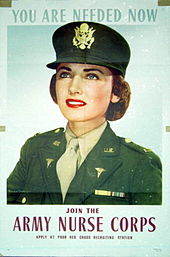
As Campbell (1984) shows, the nursing profession was transformed past Earth War Two. Regular army and Navy nursing was highly bonny and a larger proportion of nurses volunteered for service higher than any other occupation in American society.[84] [85]
The public paradigm of the nurses was highly favorable during the war, as the simplified by such Hollywood films every bit "Weep 'Havoc'" which made the selfless nurses heroes under enemy fire. Some nurses were captured past the Japanese,[86] just in practice they were kept out of harm's manner, with the nifty majority stationed on the domicile front. However, 77 were stationed in the jungles of the Pacific, where their uniform consisted of "khaki slacks, mud, shirts, mud, field shoes, mud, and fatigues."[87] [88] The medical services were large operations, with over 600,000 soldiers, and ten enlisted men for every nurse. Nearly all the doctors were men, with women doctors allowed only to examine the WAC.[89] [90]
President Franklin D. Roosevelt hailed the service of nurses in the war effort in his final "Fireside Chat" of January 6, 1945. Expecting heavy casualties in the invasion of Japan, he called for a compulsory draft of nurses. The casualties never happened and at that place was never a draft of American nurses.[91] [92]
Britain [edit]
During World War II, nurses belonged to Queen Alexandra'due south Royal Military Nursing Service (QAIMNS), as they had during World War I, and as they remain today. (Nurses belonging to the QAIMNS are informally chosen "QA"s.) Members of the Ground forces Nursing Service served in every overseas British armed forces campaign during World War 2, every bit well every bit at war machine hospitals in United kingdom of great britain and northern ireland. At the beginning of World State of war Ii, nurses held officeholder condition with equivalent rank, merely were not commissioned officers. In 1941, emergency commissions and a rank construction were created, conforming with the structure used in the rest of the British Ground forces. Nurses were given rank badges and were now able to exist promoted to ranks from Lieutenant through to Brigadier.[93] Nurses were exposed to all dangers during the War, and some were captured and became prisoners of war.
Germany [edit]
Frg had a very large and well organized nursing service, with three main organizations, ane for Catholics, one for Protestants, and the DRK (Red Cross). In 1934 the Nazis set upwards their own nursing unit, the Brown Nurses, absorbing one of the smaller groups, bringing it upward to 40,000 members. Information technology set up upwards kindergartens, hoping to seize command of the minds of the younger Germans, in competition with the other nursing organizations. Civilian psychiatric nurses who were Nazi political party members participated in the killings of invalids, although the process was shrouded in euphemisms and denials.[94]
Armed services nursing was primarily handled by the DRK, which came under fractional Nazi command. Front line medical services were provided by male person medics and doctors. Scarlet Cantankerous nurses served widely within the armed forces medical services, staffing the hospitals that perforce were close to the front lines and at adventure of bombing attacks. Two dozen were awarded the highly prestigious Fe Cross for heroism nether fire. They are amongst the 470,000 German women who served with the military machine.[95]
Run into likewise [edit]
- History of Nursing in the United Kingdom
- History of nursing in the United states of america
- History of Philippine nurses in the U.s.
- Nursing in Australia
- Nursing in Frg
- Nursing in Canada#History
- Nursing in Hong Kong
- Nursing in India
- Nursing in Nippon
- Nursing in Islam
- Nursing in Kenya
- Nursing in Pakistan
- Nursing in the Philippines
- Nursing in Taiwan
- Nursing in the United States
- List of nurses
References [edit]
- ^ "Physicians: What's in a Name?". Archived from the original on 2017-11-16. Retrieved 2016-03-05 .
- ^ Florence Nightingale (1820–1910)
- ^ A history of nursing; the evolution of nursing systems from the earliest times to the foundation of the first English language and American training schools for nurses, by Adelaide Nutting and Lavinia L. Dock, G.P. Putnam'due south Sons, 1907
- ^ A History of Nursing, from Ancient to Modern Times: A World View by Isabel Maitland Stewart, Anne L. Austin, 1962
- ^ DeWit, Susan (2009). Fundamental Concepts And Skills for Nursing. Missouri: Saunders Elsevier. p. 964. ISBN9781416052289.
- ^ Geoffrey Blainey; A Short History of Christianity; Penguin Viking; 2011.
- ^ Catholic Encyclopedia - [1] (2009)
- ^ Roderick Due east. McGrew, Encyclopedia of Medical History (1985), p. 135.
- ^ Catholic Encyclopedia: Hospitals. Newadvent.org (1910-06-01). Retrieved on 2013-07-28.
- ^ Cosmic ENCYCLOPEDIA: History of Medicine. Newadvent.org (1911-x-01). Retrieved on 2013-07-28.
- ^ [two] Archived March 26, 2012, at the Wayback Automobile
- ^ James Edward McClellan and Harold Dorn, Science and Engineering science in World History: An Introduction (The Johns Hopkins Academy Printing, 2006), p.99,101.
- ^ Byzantine medicine
- ^ "Many centuries before Florence Nightingale, this Muslim woman introduced nursing to the Arabic world"
- ^ See Florez, "Espana Sagrada", 13, 539; Heusinger, "Ein Beitrag", etc. in "Janus", 1846, I.
- ^ a b Capitulary Duplex, 803, chapter three
- ^ Virchow in "Gesch. Abhandl.", II
- ^ Sethina Watson, "The Origins of the English Infirmary," Transactions of the Royal Historical Society, Sixth Series (2006) sixteen:75-94 in JSTOR
- ^ Geoffrey Blainey; A Short History of Christianity (Penguin Viking; 2011); pp. 214–15.
- ^ Mary E. Fissell, "Introduction: Women, Wellness, and Healing in Early on Modernistic Europe," Message of the History of Medicine (2008) 82#i pp 1–17
- ^ Monica Greenish, "Women'due south Medical Practice and Health Care in Medieval Europe," in Sisters and Workers in the Middle Ages, ed. J. M. Bennett et al. (University of Chicago Press, 1989), pp. 39–78
- ^ a b Tim McHugh, "Expanding Women's Rural Medical Piece of work in Early on Modern Brittany: The Daughters of the Holy Spirit," Journal of the History of Medicine and Allied Sciences (2012) 67#3 pp. 428–56. in projection MJUSE
- ^ Catholic ENCYCLOPEDIA: Knights of Republic of malta. Newadvent.org (1910-06-01). Retrieved on 2013-07-28.
- ^ Catholic Encyclopedia: St. Roch. Newadvent.org (1912-02-01). Retrieved on 2013-07-28.
- ^ "Catechism of the Catholic Church". SC Borromeo.org . Retrieved 15 April 2020.
- ^ Colin Jones, The Charitable Imperative. Hospitals and Nursing in Ancien Regimé and Revolutionary France (Routledge, 1989), pp. 89–205.
- ^ Susan E. Dinan, Women and Poor Relief in Seventeenth-Century France. The Early History of the Daughters of Clemency (Ashgate, 2006).
- ^ Jacques Léonard, "Femmes, Organized religion et Médecine: Les Religieuses qui Soignent, en French republic au XIXe Siècle," Annales: Economies, Societes, Civilisations (1977) 32#v pp. 887–907
- ^ C. Scott Dixon; et al. (2009). Living With Religious Diversity in Early-Modern Europe. Ashgate. pp. 128–30.
- ^ a b Amy E. Leonard, "Female Religious Orders," in R. Po-chia Hsia, ed., A Companion to the Reformation World (2004) pp 237–254
- ^ Andrew Cunningham; Ole Peter Grell (2002). Wellness Intendance and Poor Relief in Protestant Europe 1500–1700. Routledge. pp. 130–33.
- ^ Virpi Mäkinen (2006). Lutheran Reformation And the Law. BRILL. pp. 227–29.
- ^ Keir Waddington (2003). Medical Education at St. Bartholomew's Hospital, 1123–1995. Boydell & Brewer. p. 18.
- ^ Deborah E. Harkness, "A View from the Streets: Women and Medical Piece of work in Elizabethan London," Message of the History of Medicine (2008) 82#1 pp. 52–85
- ^ Merry East. Wiesner-Hanks, Women and Gender in Early Modernistic Europe (Cambridge U.P., 1993), pp. 84, 94–95.
- ^ Sister Mildred Winter, "Deaconess," in Julius Bodensieck, ed. The Encyclopedia of the Lutheran Church (Minneapolis: 1965) 659–64
- ^ Gerberding, GH (1909). Life and Messages of W. A. Passavant, D. D. Greenville, PA: Young Lutheran Co. pp. 176, 180.
- ^ Cynthia A. Jurisson, "The Deaconess Movement," in Rosemary Skinner Keller et al., eds. Encyclopedia of Women and Faith in North America (Indiana U.P., 2006). p. 828-ix online
- ^ "Florence Nightingale Faculty of Nursing & Midwifery | Florence Nightingale Faculty of Nursing, Midwifery & Palliative Care | Rex'south College London". kcl.ac.uk . Retrieved 2020-04-14 .
- ^ The School for Nurses
- ^ "Mary Seacole, Creole Doctress, Nurse and Healer". Helen Rappaport. 2018-10-21. Retrieved 2020-04-14 .
- ^ florence nightingale. notes on nursing by florence nightingale.
- ^ Elizabeth Anionwu, Mary Seacole: Nursing in Many Lands https://www.uwl.ac.uk/sites/default/files/Academic-schools/College-of-Nursing-Midwifery-and-Healthcare/Spider web/PDF/Elizabeth%20Anionwu%20Papers/Mary%20Seacole%20-%20nursing%20care%20in%20many%20lands%20May2012.pdf
- ^ "Our History". British Army Website. Archived from the original on 28 October 2011. Retrieved 31 October 2011.
- ^ a b "QAIMNS World State of war I Queen Alexandra's Imperial Armed services Nursing Service QAIMNS Nurses". qaranc.co.u.k.. Retrieved 31 Oct 2011.
- ^ Crisp, J., & Taylor, C. Potter & Perry's fundamental of nursing (3rd ed. 2009).
- ^ a b c d Link text Archived 2011-12-29 at the Wayback Machine, boosted text.
- ^ Alison Prentice, Canadian Women: A History (1988).
- ^ C. Lesley Biggs, "The Example of the Missing Midwives: A History of Midwifery in Ontario from 1795–1900," Ontario History, (1983) 75#one pp. 21–35
- ^ Jo Oppenheimer, "Childbirth in Ontario: The Transition from Home to Infirmary in the Early Twentieth Century," Ontario History, (1983) 75#1 pp. 36–60
- ^ Anne Woywitka, "Pioneers In Sickness and in Health." Alberta History 2001 49(1): sixteen–xx.
- ^ Sharon Richardson, "Women'southward Enterprise: Establishing The Lethbridge Nursing Mission, 1909-1919." Nursing History Review 1997 5: 105–130. 1062–8061
- ^ Sharon Richardson, "Political Women, Professional Nurses, and the Cosmos of Alberta's District Nursing Service, 1919-1925." Nursing History Review 1998 6: 25–50. 1062–8061
- ^ Sharon Richardson, "Frontier Health Intendance: Alberta'south Commune and Municipal Nursing Services, 1919 to 1976." Alberta History 1998 46(1): two–9.
- ^ Friedrich Katz, The Life and Times of Pancho Villa. Stanford: Stanford University Press 1998, 291.
- ^ Katrin. Schultheiss, "Gender and the Limits of Anti-Clericalism: The Secularization of Hospital Nursing in France, 1880–1914," French History (1998) 12#iii pp 229-245
- ^ Katrin Schultheiss, Bodies and Souls: politics and the professionalization of nursing in French republic, 1880–1922 (2001), pp. iii–11, 99, 116
- ^ Barker, Anne Chiliad. (2009). Advanced practice nursing: essential knowledge for the profession. Sudbury, Mass.: Jones and Bartlett Publishers. pp. ten–11. ISBN978-0763748999.
- ^ Robinson, Jane (2004), Mary Seacole: The Charismatic Black Nurse who became a heroine of the Crimea.
- ^ Loma, Richard (1855), A week at Port Royal.
- ^ U.S. Bureau of the Demography, Historical Statistics of the United States (1976) p 78
- ^ Kalisch and Kalisch, The Advance of American Nursing (1978) p. 360
- ^ Bernadette McCauley, Who shall accept intendance of our sick?: Roman Catholic sisters and the development of Catholic hospitals in New York Urban center (Johns Hopkins UP, 2005)
- ^ Historical Statistics of the United States (1976) p 76
- ^ Henrietta Blackmore. The showtime of women'south ministry: the revival of the deaconess in the nineteenth-century Church of England. Boydell Press. p. 131.
- ^ Encounter Christ Lutheran Church of Baden Archived 2009-ten-07 at the Wayback Car
- ^ Wade Crawford Berkeley, History of Methodist Missions: The Methodist Episcopal Church 1845–1939 (1957) pp. 82, 192–93 482
- ^ C.D. Naumann, In The Footsteps of Phoebe (Concordia Publishing House, 2009)
- ^ United states Public Wellness Service, Municipal Health Section Practice for the Twelvemonth 1923 (Public Health Bulletin # 164, July 1926), pp. 348, 357, 364
- ^ Mercedes Graf, "Band Of Angels: Sis Nurses in the Spanish–American State of war," Prologue (2002) 34#iii pp 196–209. online
- ^ a b c Quinn, Shawna M. (2010). "Agnes Warner and the Nursing Sisters of the Great War" (PDF). Goose Lane editions and the New Brunswick Armed services Heritage Projection. ISBN978-0-86492-633-3. Archived from the original (PDF) on 23 November 2010. Retrieved 28 October 2011.
- ^ Harry H. Moore, "Health and Medical Practice" in President's Research Commission on Social Trends, Recent Social Trends in the United States (1933) p. 1064
- ^ Brenda McBride, Quiet Heroines: Story of the Nurses of the 2d World War (1985)
- ^ Roy Terry, "McDougall, Grace Alexandra (1887–1963)", Oxford Dictionary of National Biography, (2004); online edn, May 2006 accessed 6 March 2013
- ^ Janet Lee, "A Nurse and a Soldier: Gender, Class and National Identity in the Get-go World War Adventures of Grace McDougall and Flora Sandes," Women's History Review (2006) 15#1 pp. 83–103; Janet Lee, War girls: the First Assistance Nursing Yeomanry in the Offset Earth War (Manchester University Press, 2012)
- ^ a b "Nurses (Canadian War machine)". Canadian Military machine History Gateway. Archived from the original on twenty January 2012. Retrieved 28 October 2011.
- ^ Wilson-Sammie, Katherine M. (1981). Lights Out! A Canadian Nursing Sis's Tale. Mikey. p. 168. ISBN9780919303515.
- ^ 3rd Australian Full general Hospital. The AIF Project.
- ^ Guns and Brooches: Australian Army Nursing Boer - Gulf State of war by Jan Bassett
- ^ Ruth Rae, "Reading between Unwritten Lines: Australian Ground forces Nurses in Republic of india, 1916–nineteen", Journal of the Australian War Memorial (2001), #36 pp. i+
- ^ Susan Reverby, Ordered to Care, pp. 98, 103, 105
- ^ Cynthia Toman, "Front Lines and Frontiers: War as Legitimate Work for Nurses, 1939–1945," Social History/Histoire Sociale (2007) 40#79 pp. 45–74.
- ^ Cynthia Toman, An Officer and a Lady: Canadian Military Nursing and the 2nd World War (2007)
- ^ Deann Campbell, Women at State of war with America: Individual Lives in a Patriotic Era (1984) ch 2
- ^ Philip A. Kalisch and Beatrice J. Kalisch, American Nursing: A History (4th ed. 2003)
- ^ Elizabeth Norman, We Band of Angels: The Untold Story of American Nurses Trapped on Bataan by the Japanese (1999)
- ^ Mary T. Sarnecky, A history of the U.Due south. Ground forces Nurse Corps (1999) p. 199 online
- ^ Udin, Zaf. "Nursing Uniforms of the Past and Present". Pulse Uniform.
- ^ Campbell, Women at War with America (1984) ch 2
- ^ "Scrub Reviews: "Nurses, Don't Work Some other Shift Until Youv'e Read This!"". ScrubReviews.com. 2020-08-12. Retrieved 2020-09-18 .
- ^ see 1945 Radio News : WA4CZD : Free Download & Streaming : Cyberspace Archive
- ^ "Scrub Reviews: "What are Antimicrobial Scrubs & Should Y'all Purchase Them?"". ScrubReviews.com. 2020-09-09. Retrieved 2020-09-18 .
- ^ "QA World State of war Two Nursing". qaranc.co.great britain. Retrieved 31 October 2011.
- ^ Bronny Rebekah McFarland-Icky, Nurses in Nazi Frg (Princeton University Printing, 1999)
- ^ Gordon Williamson, Globe War II High german Women'southward Auxiliary Services (2003) pp. 34–36
Farther reading [edit]
- Andrist, Linda C. et al. eds. A History of Nursing Ideas (Sudbury, Mass.: Jones and Bartlett, 2006), 504 pp. forty essays; focus on professionalization
- Bullough, Vern L. and Bonnie Bullough. The Emergence of Modern Nursing (2nd ed. 1972)
- Dock, Lavinia Lloyd. A Brusque history of nursing from the earliest times to the nowadays twenty-four hours (1920)full text online; abbreviated version of her four book A History of Nursing vol iii online
- Donahue, Thousand. Patricia. Nursing, The Finest Fine art: An Illustrated History (3rd ed. 2010), includes over 400 illustrations; 416pp; excerpt and text search; full text online
- Fairman, Julie and Joan E. Lynaugh. Disquisitional Intendance Nursing: A History (2000) extract and text search
- Helmstadter, Carol, and Judith Godden, eds. Nursing before Nightingale, 1815–1899 (Routledge, 2016).
- Hardy, Susan and Corones, Anthony, "The Nurse'southward Uniform every bit Ethopoietic Fashion", Style Theory, Vol.21, No.5. (2015), pp. 523–552. doi=10.1080/1362704X.2016.1203090
- Snodgrass, Mary Ellen. Historical Encyclopedia of Nursing (2004), 354pp; from ancient times to the present
United States [edit]
- Bradshaw, Ann. "Compassion in nursing history." in Providing Compassionate Wellness Care: Challenges in Policy and Exercise (2014) ch two pp 21+.
- Choy, Catherine Ceniza. Empire of care: Nursing and migration in Filipino American history (2003)
- D'Antonio, Patricia. American Nursing: A History of Knowledge, Authority, and the Significant of Work (2010), 272pp extract and text search
- Fairman, Julie and Joan East. Lynaugh. Disquisitional Care Nursing: A History (2000) excerpt and text search
- Judd, Deborah. A History of American Nursing: Trends and Eras (2009) 272pp excerpt and text search
- Kalisch, Philip A., and Beatrice J. Kalisch. Advance of American Nursing (tertiary ed 1995) ; 4th ed 2003 is titled, American Nursing: A History
- Kaufman, Martin, et al. Lexicon of American Nursing Biography (1988) 196 short biographies by scholars, with further reading for each
- Reverby, Susan M. Ordered to Care: The Dilemma of American Nursing, 1850–1945 (1987) excerpt and text search
- Roberts, Mary M. American nursing: History and interpretation (1954)
- Sarnecky, Mary T. A history of the U.S. Army Nurse Corps (1999) excerpt and text search
- Sterner, Doris. In and Out of Harm's Way: A History of the Navy Nurse Corps (1998)
- Ward, Frances. On Duty: Ability, Politics, and the History of Nursing in New Jersey (2009) Excerpt and text search
Britain [edit]
- Abel-Smith, B. The Hospitals 1800–1948: A Study in Social Administration in England and Wales (1964) London: Heinemann.
- Allan, P. and Jolley, M. Nursing, Midwifery and Wellness Visiting since 1900 (1982) London: Faber.
- Baly, M. (1986) Florence Nightingale and the Nursing Legacy, (1986) London: Croom Captain.
- Baly, M. A History of the Queen's Plant: 100 Years 1887–1987 (1987) London: Croom Captain
- Bendall, East. and Raybould, Eastward. A History of the General Nursing Council for England and Wales 1919–1969 (1969) London: H.One thousand. Lewis.
- Cowell, B. and Wainwright, D. Behind the Blue Door: The History of the Royal College of Midwives 1881–1981 (1981) London: Bailliere Tindall.
- Davis, C., ed. Rewriting Nursing History (1980) London: Croom Helm.
- Dingwall, Robert, Anne Marie Rafferty, Charles Webster, eds. An Introduction to the Social History of Nursing (1988) online
- Dingwall, R. and Mclntosh, J., eds. Readings in the Sociology of Nursing (1978) Edinburgh: Churchill Livingstone.
- McBride, Brenda. Quiet Heroines: Story of the Nurses of the Second Earth State of war (1985)
- Maggs, C. ed. Nursing History: The Land of the Art (1986) London: Croom Helm.
- Santos, Eastward.V. and Stainbrook, E. "A History of Psychiatric Nursing in the 19th Century," Journal of the History of Medicine (1949) iv#1 pp 48–74.
- Scull, A. Museums of Madness: The Social Organisation of Insanity in 19th Century England (1979) London: Allen Lane.
- Smith, F.B. The Peoples Health 1830–1910 (1979) London: Croom Helm.
- Smith, F.B. Florence Nightingale: Reputation and Power (1982) London: Croom Captain.
- Summers, A. "Pride and Prejudice: Ladies and Nurses in the Crimean War", History Workshop (1983) 16:33-56. excerpt
- Summers, A. Angels and Citizens: British Women as Armed forces Nurses 1854–1914 (1988) London: Routledge & Kegan Paul.
- Sweet, Helen. "Establishing Connections, Restoring Relationships: Exploring the Historiography of Nursing in Britain," Gender and History (2007) nineteen#three pp. 565–580.
- Webster, C. "Nursing and the Crisis of the Early on National Health Service," Message of the History of Nursing Group (1985) 7:4-12.
- White, R. ed. Political Issues in Nursing: Past, Present and Future (1985) Chichester: John Wiley and Sons.
Canada [edit]
- Biggs, C. Lesley. "The Instance of the Missing Midwives: A History of Midwifery in Ontario from 1795–1900," Ontario History, (1983) 75#1 pp 21-35
- Coburn, David. "The evolution of Canadian nursing: Professionalization and proletarianization." International Journal of Health Services (1988) 18#3 pp: 437-456.
- Gibbon, John Murray, and Mary S. Mathewson. Three centuries of Canadian nursing (Macmillan Co. of Canada, 1947)
- Drape, Jessie, Funke-Furber, Jeanette, and Vera McIvor. "The forgotten revolution: the Priory Method : a restorative care model for older persons" (Victoria, BC, Trafford, 2003).
- McPherson, Kathryn M. Bedside matters: The transformation of Canadian nursing, 1900-1990 (University of Toronto Press, 2003)
- Oppenheimer, Jo. "Childbirth in Ontario: The Transition from Dwelling house to Hospital in the Early on Twentieth Century," Ontario History, (1983) 75#one pp 36-sixty
- Toman, Cynthia. "Front Lines and Frontiers: War every bit Legitimate Work for Nurses, 1939–1945," Social History/Histoire Sociale (2007) xl#79 pp 45-74.
- Toman, Cynthia. An Officer and a Lady: Canadian Armed forces Nursing and the 2nd World State of war (2007)
- Woywitka, Anne. "Pioneers In Sickness and in Wellness." Alberta History 2001 49(i): 16-xx.
China [edit]
- Chan, Sally, and Frances Wong. "Development of basic nursing education in China and Hong Kong." Periodical of advanced nursing 29.6 (1999): 1300-1307. online
- Chen, Kaiyi. "Missionaries and the early on development of nursing in Mainland china." Nursing History Review 4 (1996): 129-149.
- Davis, Anne J., et al. "The young pioneers: first baccalaureate nursing students in the People's Commonwealth of Cathay." Periodical of advanced nursing 17.10 (1992): 1166-1170. online
- Grypma, Sonya. "Withdrawal from Weihui: Communist china missions and the silencing of missionary nursing, 1888–1947." Nursing inquiry fourteen.4 (2007): 306-319.
- Xu, Yu, Z. Xu, and Jainhui Zhang. "The nursing instruction organization in the People'southward Republic of Red china: evolution, structure and reform." International Nursing Review 47.iv (2000): 207-217. online
Bharat [edit]
- Healey, Madelaine (2014). Indian Sisters: A History of Nursing Leadership and the Country, 1907–2007. Routledge. ISBN978-i-317-56009-8.
Europe [edit]
- McFarland-Icky, Bronny Rebekah. Nurses in Nazi Frg (Princeton Academy Printing, 1999)
- Rafferty, Anne Marie. "Tiptoeing towards a history of nursing in Europe" Nursing history review: official journal of the American Association for the History of Nursing 22 (2013): 107–113.
Source: https://en.wikipedia.org/wiki/History_of_nursing
0 Response to "Blue Cross 5 Day Reviews Skilled Nursing Stay"
Post a Comment